


What is Exonumia?
Exonumia is the name given to collectable items that sit alongside coins and banknotes, including tokens, medals, checks, advertising pieces and other related numismatic items. These pieces can be historically fascinating and, in some cases, highly collectable.
Exonumia was defined by the Token and Medal Society (TAMS) founding member, Russell Rulau in 1960. It refers to collectible items other than coins or paper money, as medals or tokens. Most collectors expand that definition to include a wide range of items defined below.
What is a token?
Strictly defined, a token is any substitute for the money issued by governments. The most common form of token is a metal disc, similar to a coin, on which is inscribed the value and the issuer. In theory, tokens were redeemable only by the issuer, but some were accepted widely and often circulated just as coins. In practice, many other items, such as advertising pieces, are also called tokens as opposed to medals.
Why were tokens issued?
Initially, tokens were made to compensate for shortages of coins in circulation. As specific needs arose, tokens were found to be effective even when there was no lack of circulating coins.
How are tokens collected?
Given the wide variety of tokens, collectors tend to specialise by type, geographical area, or other subdivisions. For instance, a collector of trade tokens may just collect those from one state, or by one particular type of issuing business (e.g. General Store, Saloon, or Billiard Hall). Some may have a collection of wooden nickels representing one from each state while others may try to collect every variety known from a single restaurant chain. The way tokens are collected is an individual choice – that contributes to the interest!
We have a wealth of knowledge regarding tokens and stock a wide range of them on our online shop. So why not contact us today and we will be more than happy to answer your questions.
British tokens and exonumia
Britain has an especially rich history of tokens, because official small change was often in short supply. Collectors usually group them by period:
- 17th-century trade tokens: small copper and brass farthings and halfpennies issued by tradesmen and towns, mostly between 1648 and 1672, when the Crown began issuing regal copper halfpennies and farthings.
- 18th-century tokens: from 1787, starting with the Parys Mine Company’s “Druid” pennies from Anglesey, industrialists and shopkeepers issued large, well-made copper tokens. Collectors often call them Conder tokens, after an early catalogue of them.
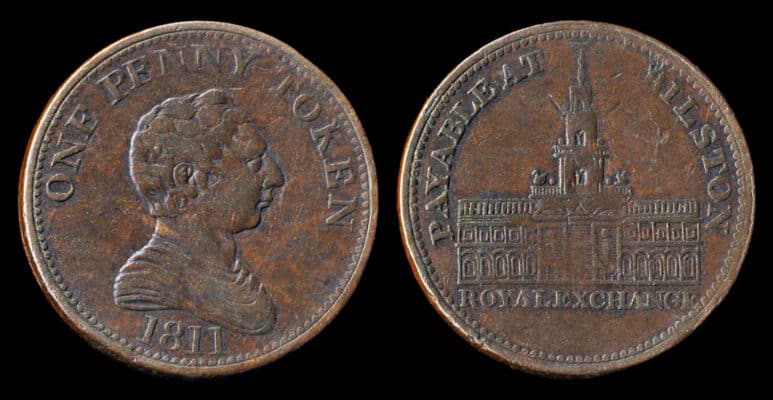
- 19th-century tokens: silver and copper tokens issued around 1811 to 1815, when coin shortages during the Napoleonic Wars were at their worst.
Beyond tokens, British exonumia includes historic and commemorative medals, communion tokens, pub and market checks, and unofficial farthings. You can browse the tokens and medals we have in our online shop.
Have tokens or medals to identify?
B and G Coins has experience with tokens, medals and other exonumia. If you have an item you would like identified or valued, send us clear photos through our free online valuation service and we will advise where possible.
Original image source: https://www.goldenruleenterprises.org/product/great-britain-bilston-penny-token-1811/
Original article source: http://www.tokenandmedal.org/FAQ/FAQ.html
