


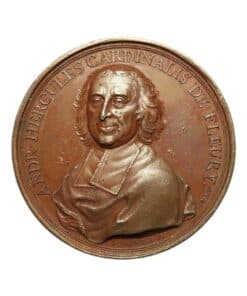




Obverse: Facing bust of Cardinal de Fleury; signed: AET. 81. ET I. DASSIER. F..
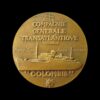
Reverse:HIS PACEM REDDIDIT ARMIS / M.DCC.XXXVI. HIS PACEM REDDIDIT ARMIS, staff of Aesculapeus set among symbols of art, industry, commerce, and war; in exergue.
55mm, 65.37 g,
Chocolate tone, minor surface marks
NEF
André Hercule de Fleury (born in Lodève on June 22, 1653; died in Issy-les-Moulineaux on January 29, 1743) was a French clergyman and statesman who served as the *de facto* chief minister to the young King Louis XV from 1726 to 1743.
Jean Dassier (born in Geneva on October 17, 1676; died in the same city on November 12, 1763) was a Genevan medalist.
Historical Context
LOUIS XV, KNOWN AS “THE BELOVED”
(September 1, 1715 – May 10, 1774)
Louis XV succeeded Louis XIV on September 1, 1715, with Philippe d’Orléans serving as sole regent. The Quadruple Alliance of 1717 aimed to maintain the European balance of power among France, Austria, England, and the United Provinces. During his visit to France, Tsar Peter I signed a bilateral agreement. In 1718, Abbé Dubois became Secretary of State for Foreign Affairs. Consecrated Archbishop of Cambrai in 1720 and appointed Prime Minister in 1722, he died on August 10, 1723. France declared war on Spain in 1719 to prevent Philip V from overthrowing the Regent. The capture of San Sebastián and Hondarribia marked the end of hostilities. In 1720, Philip V joined the Quadruple Alliance and renounced the French throne under the Treaty of Madrid. The first Masonic lodge was founded in France in 1721. Louis XV was consecrated at the age of twelve on October 25, 1722. On February 15, 1723, he was declared of age. The Regent was succeeded by the Duke of Bourbon, who became Prime Minister. Philippe d’Orléans died on December 2.
Related products

Historical Medals


Historical Medals


Historical Medals
British 1986 Royal Mint Medal – Swan Mear and Wood of 1984-1986 – ‘In the Footsteps of Scott’


Historical Medals
Historical Medals


Historical Medals


Historical Medals
BRITISH 1967 SIR FRANCIS CHICHESTER GYPSY MOTH COMMEMORATIVE MEDALLION