


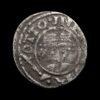
Obverse
Bearded portrait of St Martial in an inner circle, legend around starting 19h.
Script: Latin
Lettering: SES • MARCIAL
Unabridged legend: Sanctus Marcial
Translation: Saint Martial.
Reverse
Cross with 4 pairs of dots within an inner circle, legend around.
Script: Latin
Lettering: ✠ LEMOVICENSIS
Unabridged legend: Lemovicensis
Translation: [Denier] of Limoges.
Mint
Limoges, France
Ref: PA# 2291 ; 2296 ; 2298, Dy féodales# 883-884 ; 886-893, Boudeau# 390
Good Very Fine
Mentioned for the first time in a document dated 1106 (cf. Henri Hugon, p. 80-93), the denarius of the abbey of Saint-Martial de Limoges is inspired by that of the priory of Souvigny in Bourbonnais, which appeared between 1095 and 1098 and features the bust of the beardless Saint Mayeul. It differs in particular by the beard worn by Saint Martial, from which it logically derives its name “barbarin” (“Lemovicensis barbata moneta” = “Limoges currency with a beard”). This denarius enjoyed great credit and was minted until around 1245.
On the right, the “E” in “SES” is in fact a square C, with the vertical bar crossed out horizontally to form a cross and thus abbreviate the word. This type of abbreviation is also found, among others, on the denarii of the bishopric of Clermont, which also feature a frontal bust.
Three groups of barbarine denarii can be identified from the various treasures unearthed: denarii with the legend SES MARCIAL, those with the legend S MARTIAL and those with the cross cantoned by various symbols (star and G in particular). The G barbarin is attributed to Viscount Gui V (1199-1230), who had barbarins minted at his château in Aixe-sur-Vienne in 1211.
There are many varieties: on the right, the effigy of the saint (face more or less elongated, position of hair, length of beard), the width of the bust, accosted or not, etc. On the reverse, the simple or beaded cross, with different combinations in the number and positioning of the canting rings.
Related products


Europe