


Our standard valuation options are as follows:
- Free Service: We provide a free no obligation valuation service for small requests from private individuals who are looking for basic information, identification and potential values. No more than 6 individual items (unless previously agreed, or with a view to sell to us).
- We provide a valuation for private collections where there is a view to sell. This is initially chargeable, but the charge is refunded should we subsequently purchase the collection. Charges commence at £150 or 5% of the valuation total, whichever is the greater.
- Professional Service – We provide professional services to Auctioneers, Museums and similar. These are chargeable either on a daily or contractual rate basis, please send your detailed requirement for a quote. (Charity work is provided free of charge upon agreement).
- Probate – We act for solicitors and executors in estate valuation. We can provide a full insurance and indemnity backed valuation report, which is chargeable and prices start at Charges commence at £150 or 5% of the valuation total, whichever is the greater and depending on size of estate and time needed to prepare.
- Insurance valuation – we are able to provide a fully indemnified and insurance industry accepted insurance valuation for single items or larger collections, please contact us with your requirements for a quotation.
If you can therefore provide us with a little more information, I would be pleased to give you our assistance.
Below we explain some of the more common UK Coin values, along with the scams and misleading information to be found online at auction sites, which we have created due to around 70% of emails and phone calls we receive being of this type of enquiry:
You might specifically find the following of interest.
The ‘New ‘ Pence con trick
The Seeding Scam
The Upside down edge lettering myth
As you may or may not be aware, the value of any coin/medal/token/Banknotes relies on three main criteria.
1) The rarity of the item, how many were minted and how many are known to remain.
2) The condition of the coin. In most cases baring exceptionally rare items, the condition needs to be excellent to attract the higher prices. The difference between an average coin and an excellent one of the same type, can see a variation in hundreds if not thousands of pounds in value.
3) The metal it is made from. As you might expect, Gold, Platinum and Silver have a metal value even if the coin is in poor condition.
Pre Decimal Coins
In respect of pre decimal coins, it is worth understanding that with a few exceptions, these were minted in their millions and many survive in excellent condition today. For this reason they have little numismatic value until in the case of copper coins, they go back to pre-1900 and the Victorian era. However condition is then also a consideration, as a worn ‘Bun Penny’ will still have little value unless one of the very few rare dates.
Silver coinage is the same, however from 1946 to 1920 inclusive, all silver coins actually contained 50% silver. This is unlike 1947 onwards and even those in use today, which are made of a Cupra-Nickle and as such have no value. Silver coins minted from 1919 and back were made of 92.5% silver. What this means is that despite their having no collectable value, (unless one of a couple rare dates or in excellent condition or pre 1900 as mentioned above) they have a bullion value. You will see scrap dealers offering prices from 10 x face value (we have seen as low as 5 x) for pre 1947 and up to 40 x for pre 1920. However be aware that when you go to sell you will often be told that ‘the coins are too worn and they cannot give you the top price.’ And you will be offered much less. Also be aware that silver prices do change with the market prices.
So what this means for bullion is as follows:
Threepence (1.25p) .19p (Pre 1947) or .38p (Pre 1920)
Sixpence (2.5p) .37p or .75p
Shilling (5p) .75 or £1.50
Florin/Two Shillings (10p) £1.50 or £3.00
Halfcrown (12.5p) £1.87 or £3.75
Gold Sovereign and Half Sovereigns
In the main unless earlier Victorian and back, these have a fixed price determined by the prevailing gold price. Currently the minimum buying price bullion sovereigns and half’s is around £340 and £170 respectively, but this does change on an hour by hour basis so please confirm when you are ready to sell. There is also a premium for boxed proof coins with their COA and in some cases can achieve much higher prices.
Modern Circulating Decimal Coins
In recent times the Royal Mint has seen itself put under considerable pressure to produce ‘commemorative type coins’ in comparison with the older style one design type. This coupled with cut backs particularly in quality control, has seen considerably more of these ‘error’ types entre into circulation.
There has been much hype driven by the press and eBay as to expectation of high values for these coins ‘Commemorative’ and ‘Error’ coins, coupled with numerous copies coming in from China and elsewhere.
But the reality I am afraid, is that these coins were minted in their millions and are simply not as scarce as people think. As a curiosity and to a ‘Commemorative’ collector they may achieve a little above face value, but really only on eBay (be aware that silly ‘asking prices’ will never actually sell) the two genuine exceptions to this is the 2009 Kew Gardens 50p and the 2012 ‘hidden swimmer’. This 2009 having a lower mintage, but still 210,000 and they regularly sell for between £80 and £120 at auction, the 2012 can make £2,000+.
Modern ‘Errors’
On eBay, these generally only achieve £10 to £20 at most, despite some of the high prices being asked (but not achieved) for them.
It is also worth noting that many of the supposed errors are not errors at all, nor are they recognised as such by the Royal Mint, but are due to minting techniques, such as the ‘Upside Down’ edge wording. These are in fact equally spread and are due to the way in which the minted coin ‘falls’ into the edge press.
However, ultimately the Royal Mint is the final arbiter and you may wish to contact them as well. They will be able to explain the error if it is a genuine one and confirm or otherwise that it emanated from the Royal Mint itself.
If they do confirm that it is genuine, they will provide you with a letter confirming this and that letter will give confidence to potential buyers when you come to sell it. We have found in the auctions that we run and consult on, that the letter is worth a 50% uplift in the sale price, so it is well worth getting this done.
Their contact details are to be found here: https://www.royalmintmuseum.org.uk/quick-links/contact-us/
The ‘New ‘ Pence con trick
When the new decimalised currency was introduced officially in 1971, all of the coins had the word ‘NEW’ on them and in 1971 specifically, around 1.5 Billion of each of the 1 and 2 pence coins were minted. This making them the most common coin issued for the series thus far.
The Royal Mint decided to continue with the word ‘New’ for a period of 10 years, before removing it from the coinage in 1982. However in 1983 the Royal Mint inadvertently used the old die in error for a sample of the 2 pence’s and before it was noticed these had gone into circulation It is these that are rare and command a few hundred pound if you can find them.
I have also included below some information on other myths surrounding modern currency coins that you might find helpful.
In specific regard to 50p and £2 coins, these were issued in their million, so like pretty much every other modern currency coin they are not in an way rare and as such do not have any investment or numismatic value other than 50p or £2 respectively. But due to sheer collectors hype on eBay, you may get £2 or £3 for them there, from someone who is simply wanting to have a set. You might say that this is not a bad return. But for genuine Numismatists these are simply for spending as they were made to be used. As such, your 50p is worth just 50p when it boils down to it.
The Seeding Scam
You will sometimes see coins for sale at very high prices, sometimes £3,000.00, £5,000.00 or even £7,000.00 or more. This is called ‘seeding’ where a con artist puts on a currency coin for a lot of money hoping people will see it. They then a week later put more on at say £30 – £300 hoping people who have seen the £3,000.00 listing then buy it thinking they have a bargain.
Online auctions say that this is not illegal as they are entitled to charge what they like for their goods, but we believe it completely lack morality.
The Upside down edge lettering myth
Depending on the denomination, some coins will have edge lettering to help against counterfeiting. What you may not know though, is the edge lettering is applied before the coin has even been struck which is why some coins can end up with the edge lettering either way around. These are not errors, but simply the minting process.
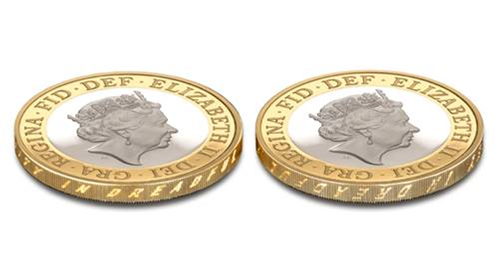
The exception to the above is the 2009 Kew Gardens 50p which sells from between £60 and £120 and Olympics Aquatics (withdrawn version) of the 50p which might achieve £500 – £800 and one early on it its discovery achieving £3,000. But I suspect that is very much an exception to the rule. It is estimated that at least 600 failed to be returned to the mint and therefore it is not unfeasible you have one of these.

The one on the left is the valuable one. There is much hype and misinformation on both eBay and in the press. These types of enquiries now make up around 70% of enquires dealers receive.
Due to this we do not deal in circulating base metal currency coins, the only Decimal commemorative type coins we do deal in are the Proof Silver/Gold/Platinum varieties as our Clients are more academic collectors and investors.